Integration of LLM and Traditional Parsing Technologies: Evolution and Best Practices in Web Data Extraction
Zhang Zibiao | Zhengzhou Shuneng Software Technology Co., Ltd. | China
1. Traditional Parsing Technologies: The Era of Rules and Statistics
1.1 Evolution of Core Methods
| Period |
Representative Technologies |
Working Principle |
Typical Tools |
| Rule-based |
Regular Expressions / XPath / CSS Selector |
Manually written pattern matching rules |
BeautifulSoup, Scrapy |
| Statistical |
CRF / HMM Sequence Labeling |
Learn entity recognition probability models from labeled data |
Stanford NER, CRF++ |
| Visual Parsing |
OCR + Text Position Recognition via Page Rendering |
Render page screenshots and recognize text positions |
Selenium + Tesseract |
1.2 Drawbacks of Traditional Parsing
1
2
|
# Example: CSS extraction of website source info - breaks if the website layout changes
price = response.xpath('//span[@class="source"]/text()').get()
|
- Poor generalization: Minor page structure changes cause rules to fail
- Lack of semantic understanding: Can only extract explicit fields (e.g., price), cannot summarize product descriptions
- Manual configuration: Requires manual configuration for each website section’s structure
- Complex attribute extraction: Weakly structured attributes (e.g., source/document numbers) are difficult to accurately extract via configuration
1.3 Advantages and Suitable Scenarios for Traditional Parsing
-
High processing efficiency: Operates on local structured character parsing, very efficient
-
Suitable for highly structured content: For example, titles, list pages, and extracting main text fragments can be done well with simple configuration
-
Parsing optimization: By configuring CSS expressions properly, small changes in web structure can be adapted to. For example:
1
2
3
4
5
|
// Here, span > li is too strict. If another tag (e.g., <div>, <em>, etc.) is inserted between span and li, it won’t match.
div[class="zsy_conlist"] > ul > span > li > a
// Change to descendant selector (space)
div[class="zsy_conlist"] > ul > span li a
// This way, regardless of how many layers are inserted between span and li, it can still match. Adapts to small page structure changes
|
2. LLM Parsing: The Semantic Understanding Revolution
2.1 Core Advantages of LLM
1
2
3
4
5
6
7
|
[Input] HTML code (including ads/irrelevant tags)
[LLM Instruction] Extract contact email and summarize main business
[Output]
{
  "email": "contact@realestate.com",
  "business": "Specialized in internet information collection and data processing solutions"
}
|
- Breaks structural dependency: Directly understands page semantics
- Handles complex tasks: Entity extraction + summary generation + custom phrasing in one step
- Anti-interference capability: Ignores frontend obfuscation (e.g., dynamic class names)
2.2 Four Accuracy Issues of LLM
| Problem Type |
Example |
Root Cause |
| Probabilistic bias |
Phone 138-0013-8000 → 13800138000 |
Seeks semantic plausibility over exact matching |
| Context truncation |
Loss of information at the end of long pages |
Window size limits (e.g., DeepSeek 64K) |
| Fails under adversarial interference |
Unable to recognize phone numbers in images |
Limitations of text-only models |
| Slower processing |
Slower extraction of specific content |
Network and model performance limitations |
3. Hybrid Parsing Architecture: Balancing Accuracy and Generalization
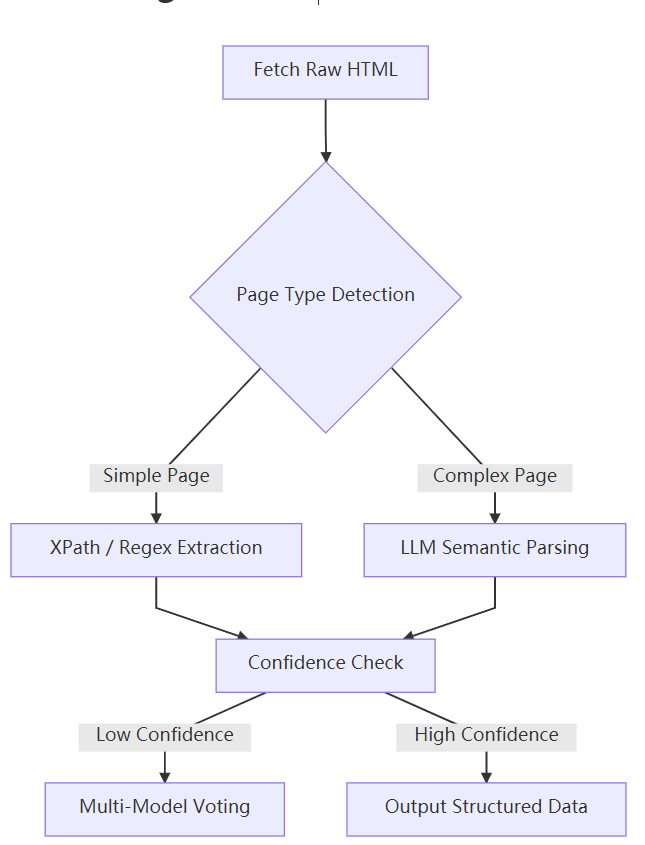
3.1 Technical Integration Design Scheme
3.2 Key Implementation Strategies
Strategy 1: Strong Constraints on LLM Output
1
2
3
4
5
6
7
|
Strictly output in JSON format:
{
  "name": "string or null",
  "phone": "Must match ^\d{3}-\d{4}-\d{4}$",
  "business": "Summary no longer than 20 characters"
}
Do not fabricate non-existent information!
|
Strategy 2: Fallback to Traditional Rules
1
2
3
4
|
def validate_phone(phone):
    import re
    pattern = r'^\d{3}-\d{4}-\d{4}$'  # Strong format validation
    return bool(re.match(pattern, phone)) if phone else False
|
Strategy 3: Dynamic Chunk Processing
 1
 2
 3
 4
 5
 6
 7
 8
 9
10
11
12
13
14
|
# Solve long page context overflow
from bs4 import BeautifulSoup

def chunk_html(html, max_tokens=2000):
    soup = BeautifulSoup(html, 'html.parser')
    chunks = []
    current_chunk = ""
    for section in soup.find_all('section'):  # Split by semantic blocks
        if len(current_chunk) + len(section.text) > max_tokens:
            chunks.append(current_chunk)
            current_chunk = section.text
        else:
            current_chunk += section.text
    return chunks
|
| Solution |
Policy-Specific Attribute Accuracy |
Main Text Accuracy |
Cost/1K Pages |
Layout Adaptability |
| Pure Traditional Rules |
68% |
95% |
$0.01 |
❌ |
| Pure LLM (DeepSeek) |
96% |
83% |
$0.15 |
✅ |
| Hybrid Architecture |
98% |
97% |
$0.08 |
✅ |
4.1 Technology Stack Components
| Component |
Recommended Tool |
Function |
| Crawler Framework |
Crawl-for-AI / selenium |
Webpage fetching |
| Dynamic Rendering |
chrome-driver |
Handle JS-loaded content |
| LLM Parsing |
DeepSeek-V3 + glm:GLM-4-Flash |
Summary generation & attribute extraction |
| Rule Engine |
Custom Python validation library |
Key field format validation |
| Proxy Service |
Bright Data |
IP rotation to avoid bans |
4.2 Workflow
 1
 2
 3
 4
 5
 6
 7
 8
 9
10
|
sequenceDiagram
    General Collection System->>+chrome: Render dynamic page
    chrome-->>-General Collection System: Return complete HTML
    General Collection System->>+Redis: Read website section structure configuration
    Redis-->>-General Collection System: Return section configuration and parse key content
    General Collection System->>+DeepSeek: Send prompt and content to be parsed
    DeepSeek-->>-Validator: Return JSON data
    Validator->>+Regex: Validate results
    Regex-->>-Output: Correct invalid formats
    Output->>ES: Store structured data
|
4.3 Benefit Analysis
- Collection efficiency and accuracy: Simple configuration for specific sites without worrying about follow-up processes; automated collection → business logic execution
- Semantic understanding and processing: LLM generates summaries and extracts specific content attributes
- Cost control: Hybrid solution reduces cost by 47% compared to pure LLM parsing
5. Conclusion: Technical Selection Guide
5.1 Recommended Solution Matrix
| Scenario |
Recommended Solution |
Reason |
| Government Gazette/API Data |
Pure rule parsing (XPath, CSS) |
Stable structure, near-zero cost |
| E-commerce Price Monitoring |
Rules + LLM Summary |
High-precision number extraction + activity description understanding |
| Business Directory Lead Generation |
LLM-centric + Rule Validation |
Adapts to diverse page styles, ensures key field accuracy |
| Dynamic Rendering SPA Applications |
Playwright + LLM Chunk Processing |
JS execution first, then long page segmented parsing |
5.2 Future Directions
- Multimodal Parsing Breakthroughs: LLM + Vision to recognize phone numbers in images / CAPTCHAs
- Self-Iterating Wrappers: LLM automatically generates and maintains XPath rules
- Lightweight Deployment: 7B-scale model local operation (e.g., Llama 3 + ONNX)
Ultimate Rules:
- Key fields (phone/email) must be validated by rules
- Semantic tasks (summary/phrasing) should be handled by LLM
- Dynamic content should be pre-rendered
- Long pages should be chunked and deduplicated
By combining LLM’s semantic generalization capability with the determinism of traditional rules, modern data extraction systems are achieving breakthroughs in both accuracy and adaptability.